Wednesday, September 29, 2010

Wilted Escarole with Anchovy & Garlic


Writing my last post made me realize that I hadn't yet shared one of my all time favorite Batali recipes with you -- Wilted Greens with Garlic and Anchovies.


I'm giving credit to Mario Batali because it is with great thanks to him and his book, Molto Italiano, that I make this escarole preparation so often. But in the end, I have a feeling that much of Italy makes this dish in their sleep.

There's not much to this recipe. Rather, it is a smart way to prepare greens that should be kept in the back of your head as a tool. Instead of a long, slow cook, this is a fast, hot preparation that leaves the greens with more crunch or chew.


Any hardy greens, like dandelion and turnip, work well, but my preference is for escarole. That pale yellow-green chicory is a favorite of mine -- cooked or in salad. Escarole has a nice note of bitterness, but is milder than most of its cousins, like endive.

I am pretty much crazy for anchovies. They mysteriously make everything taste better, adding body and saltiness. Nine out of ten times you won't even notice any fishy taste, just a bigger flavor. Worcestershire sauce is a perfect example of this.


In this recipe, the anchovies and garlic are sautéed in hot olive oil until the anchovies melt and the garlic turns a light golden brown. The recipe asks for thinly sliced garlic and whole anchovy fillets. On this particular evening, my mind was elsewhere and I chopped the garlic, and strangely I was out of anchovies and only had anchovy paste in the pantry to fall back on.

These are perfectly acceptable substitutions in a pinch, however it is more fun to bump into the sliced garlic when you are eating, and there is no question that using anchovy fillets provides an overall better flavor.


When I'm alone, I eat this dish for dinner all by itself. But that's just me... These greens taste so great with steak, but are perfectly at home served with roasted fish or chicken. To my mind, this is a very versatile dish and rather worthy of my frequent cravings.


Wilted Greens with Garlic and Anchovies

1/4 cup extra-virgin olive oil
3 anchovy fillets, rinsed
4 cloves garlic, thinly sliced
1 head escarole or 1 head or bunch other sturdy leafy green, such as dandelion or turnip greens, cut crosswise into 1/2-inch-wide ribbons, washed, and spun dry
Salt and pepper
1/2 lemon

Heat a 12-inch sauté pan over medium high heat until hot. Add the olive oil, anchovies, and garlic and cook just until the garlic is light golden brown, about 30 seconds. Add the greens and cook, stirring constantly, until wilted, about 5 minutes. Season with salt and pepper, squeeze the lemon juice over, and serve.

Serves 4

Tuesday, September 14, 2010

Mario Batali's Shellfish Couscous "Sicilian Lifeguard" Style


Would it be alright if I confessed a little something?

I had never cooked calamari at home, before last week.

Wait! That is a lie. I have cooked calamari steak before, but I'm talking about the tubes and tentacles of squid.

It was a lucky turn of events when I plucked Mario Batali's Simple Italian Food: Recipes from My Two Villages off of my bookshelf. I could resolve my calamari conundrum, revisit an old, faithful cookbook, and bring you an elegant, yet simple dinner recipe.

I'm a big Mario Batali fan.

His restaurants are pretty much terrific across the board. And his cookbooks have never failed me. Just flipping through them makes me want to cook Italian food for months on end. Simple Italian Food is loaded with gems like Spaghettini with Rock Shrimp, Anaheim Chiles, and Arugula, and Beef Braised in Barolo. His Basic Tomato Sauce is my go-to tomato sauce recipe. The addition of carrot is key.


When I spotted the Shellfish Couscous, "Sicilian Lifeguard" Style recipe, I knew I would have to make it. Unfortunately, at my first inspiration, A. bizarrely wanted something more summery than shellfish couscous. A steak, perhaps.

Huh?

Ah, well. A.'s ambivalence gave me the opportunity to use my parents and sister as guinea pigs. Getting the car repaired in Santa Monica last week placed me in close proximity to Santa Monica Seafood, so the shellfish couscous was on.


This is a straight-forward recipe, but the results are impressive because of the plethora of seafood. You end up with a soupy bowl of clams, mussels, shrimp, and calamari. The flavorings are classics like leek, garlic, tomato, white wine and parsley. The green olives and copious amount of red pepper flakes provide the twist.


I am a big sucker for couscous. I flat out love it. Certainly the couscous is what initially drew me to this recipe. So, I suppose it isn't surprising that I think the 1/2 cup of couscous in this recipe is not enough.

I don't think thickening up this dish a whole lot is a good idea, because the brothiness is very appealing. I would, however increase the couscous to 3/4 cup, not more.

My other issue with this otherwise delightful dish is the extremely potent flavor of wine. The recipe calls for two cups dry white wine, along with two cups of fish stock or clam juice. That is a lot of wine that only cooks for about six minutes after it is brought to a boil. For three of those minutes the pot is covered. The alcohol doesn't have much of a chance to evaporate.


I love wine, but I prefer a slightly less alcoholic flavor in my food. The solution is to add the wine earlier than the shellfish and to let it reduce a little. After sautéing the leeks and garlic, I would try adding the red pepper flakes, olives, tomatoes, fish stock and wine. Bring this to a boil and let simmer for about five minutes, not more, and then add the clams, mussels, shrimp and couscous. Following the recipe from here shouldn't be a problem.

The calamari cooks for only three minutes. Don't cook it any longer, because those three minutes result in beautifully tender, sweet squid. I won't hesitate to mess around in the kitchen with calamari again. I was really pleased.

This couscous is a great alternative to the seafood pastas and risottos that you may be getting tired of. I served it with an arugula salad and yellow wax beans tossed with chopped mint. No doubt, this was a very good supper.


This recipe serves four. I free-lanced a bit and added a few extra clams, mussels and shrimp. There was quite a bit left. Normally I hesitate to reheat shellfish, but a very quick warming the next night provided an excellent bed for the salmon I roasted.

Shellfish Couscous "Sicilian Lifeguard" Style

1 medium leek, halved lengthwise, cleaned and sliced into 1/4-inch half moons
4 garlic cloves, thinly sliced
6 tablespoons extra-virgin olive oil
1 tablespoon hot red pepper flakes
1 cup Sicilian green olives
1 cup chopped fresh tomatoes
3 large cherrystone clams
8 mussels, de-bearded
8 jumbo shrimp, peeled and deveined
1/2 cup quick-cooking couscous
2 cups fish stock or bottled clam juice
2 cups dry white wine
1 1/4 pounds cleaned calamari, cut into 1/4-inch rings
Salt and pepper
1/2 cup finely chopped Italian parsley

In a large flameproof casserole suitable for serving, sauté the leek and garlic in the olive oil over medium heat until very soft, about 8 minutes.

Add the red pepper flakes, olives, tomatoes, clams, mussels, shrimp, and couscous and stir to mix. Add the fish stock and wine, and bring to a boil. Cover and cook for 3 minutes over high heat, then remove the cover and stir to mix.

Add the calamari and continue to cook uncovered, stirring often, until the calamari is cooked but still tender, about 3 minutes. Season to taste with salt and pepper, then stir in the parsley. Discard any clams or mussels that did not open. Pour into a warmed serving dish and serve.

Serves 4


Monday, September 13, 2010

Baby Corn


A former beau and I used to puzzle over the existence of baby corn in Chinese food. We could never quite believe it was real -- as in not some funny faux product made in China. The kernels seemed completely fake. Could those tiny ears actually turn into the corn on the cob that we enjoyed every summer?

Plus, we never ever bumped into fresh baby corn -- not in restaurants or at farmers' markets. Our only rather sorry experiences were with the flavorless, canned baby corn.


Fast forward to many years later. Now, baby corn seems to show up every summer at a few excellent stalls at the farmer's market. Each year I forget all about it, and then the seasons change and I bump into these tiny ears at stalls like McGrath Family Farm.


If you think shucking a standard ear of corn is a pain-in-the-ass, you should really try a baby ear! They are so fragile and prone to snapping in half. The ratio of silk to actual corn is definitely not in your favor. All this being said, I think the payoff is big.


There is no denying the cute factor. And the kiddos love them. But the flavor is quite lovely as well, if you sauté them in a bit of olive oil or butter. The miniature corn turns a golden brown and takes on a slightly sweet nutty flavor. Just cook it until it is tender and tastes good to you. Sprinkle it with a little salt and pepper. It doesn't need much else -- at most a handful of chopped cilantro.


I bought the corn a week ago at the Hollywood Farmer's Market. I imagine we're probably running close to the end of the season for this little treasure, but perhaps there is a bit of time left.


Keep an eye out!

Thursday, September 09, 2010

Gazpacho Sevillano


It's the end of summer, and the farmers' markets are full of the riotous colors of peppers, glorious, fat tomatoes and the sweetest of onions. Cucumbers abound. Even garlic is at its best.


And it is hot. Here in Los Angeles, I imagine it is going to get much hotter still.

It's probably obvious where I'm going with this.

Gazpacho!


Now is the perfect time to whip up this cool coral soup. Some of you may be going, huh, coral? There are plenty of folks who like a chunky gazpacho with nicely diced colors of red and green and white.

I'm not one of them.

To me and to the Andalusians, gazpachos are creamy, puréed, bread based soups. I don't want to eat a bowl full of pico de gallo and call it soup. I love the velvety texture of traditional gazpacho with a few crispy, crunchy garnishes strewn over the top.


Looking for the best gazpacho recipe that would, frankly, remind me most of the one my mom used to make, I turned to Anya von Bremzen. Her definitive, modern work, The New Spanish Table, is a deservedly celebrated Spanish cookbook. She is nothing, if not thorough. Along with a concise history of gazpacho, there are six recipes for gazpacho within, featuring all manner of fruit and vegetable, from strawberry and fennel, cherry and beet to fig and almond.

I contentedly settled for the Gazpacho Sevillano or classic gazpacho, because I knew it would remind me, not only of my childhood summers, but of the time I spent in Barcelona with my father when I was twenty-one.


It turns out that von Bremzen's recipe is spot on.

The flavors are nicely balanced. I like the bit of cumin added to the garlic paste, and the use of the Italian frying pepper and the red bell. The balance of sherry vinegar and olive oil is just right.

The recipe asks for chilled bottled spring water. I'm not even sure what that is, so chilled, filtered water from the refrigerator is what I used.

Believe me, that was just fine.


I wasn't so certain about the results, the first night we sampled the gazpacho. To avoid forcing the vegetables through a food mill or sieve, von Bremzen suggests first puréeing the soup in a food processor and then blending it in a blender. This requires more washing up, but less effort over all.

My problem was that all that processing and blending seemed to really whip up the soup. It gave the soup a texture that was too frothy and emulsified for my taste. I was convinced that the time it would take to use a food mill or a china cap would be time well spent.


However, the soup seemed to calm down over the following two days. All the air that had been whipped into it, vanished leaving a beautifully smooth purée.

To combat this problem, I would recommend making this soup in the morning and serving it in the evening. Von Bremzen suggests that the soup be chilled for two hours. In my opinion, the soup is in no way chilled enough at this point. Making the gazpacho early in the day, will leave you with plenty of time for chilling.

I like gazpacho cold.

I also insist upon tiny little croutons to sprinkle on top. I enjoy a bit of chopped cucumber and pepper as a garnish as well, but something is starkly missing if there are no croutons. They are a cinch to make.


Cut some bread into tiny cubes. Almost any kind will do. I used a whole-grain country loaf. Fry the cubes in a pan in some hot olive oil, until crisp. Let them drain on a paper towel lined plate. You could also toss the bread cubes in some olive oil and bake in a medium-high oven for about ten minutes or so.

Easy!

Von Bremzen suggests waiting to add the garlic, if you are making the soup in advance. This may be a good suggestion, but honestly I had no problem with the garlic overwhelming the flavors even on the third day of eating the gazpacho.


And the third day was really the clincher. That's when I served it to my parents and sister. And you know what -- smash hit!

Gazpacho Sevillano

For the soup:
2 cups cubed day-old country bread, crust removed
2 medium-size garlic cloves, chopped
1 small pinch of cumin seeds or ground cumin
Kosher salt
3 pounds ripe and flavorful tomatoes, seeded and chopped
2 small Kirby (pickling) cucumbers
1 large Italian (frying) pepper, cored, seeded, and chopped
1 medium-size red bell pepper, cored, seeded, and chopped
3 tablespoons chopped red onion
1/2 cup fragrant extra-virgin olive oil
1/2 cup chilled bottled spring water, or more as needed
3 tablespoons sherry vinegar, preferably aged, or more to taste

For the garnishes:
Finely diced cucumber
Finely diced peeled granny Smith apple
Finely diced slightly under-ripe tomato
Finely diced green bell pepper
Croutons
Slivered basil leaves

Place the bread in a bowl, add cold water to cover, and let soak for 5 to 10 minutes. Drain the bread and squeeze out the excess liquid.

Using a mortar and pestle, smash the garlic, cumin, and 1/2 teaspoon salt into a paste.

Combine the tomatoes, cucumbers, Italian and red peppers, onion, bread and garlic paste in a large bowl. Mix well and let stand for about 15 minutes. Working in two batches, put the vegetable mixture into a food processor and process until smooth, adding half of the olive oil to each batch. Once each batch is finished, puree it finely in a blender, then transfer it to a large mixing bowl.

When all the puréeing is complete, whisk in the water and vinegar. The soup should have the consistency of a smoothie. Taste for seasoning, adding more salt or vinegar as needed. Refrigerate, covered until chilled for at least 2 hours.

Serve with garnishes.

Serves 8

Note: If making the gazpacho ahead of time, do not add the garlic more than 2 to 3 hours before serving, or it may overwhelm the other flavors.


Wednesday, September 08, 2010

Tomato and Ricotta Toasts


I spend so much time thinking about what to prepare for dinner that lunch all but falls by the wayside. During the week when it's just Fe and me, it doesn't matter so much.

On the weekends when A. is around, I should be trying harder. There is an art to making a lovely lunch, and I need to master it. Running out to the nearest taco shop becomes a sorry excuse for lunching after a while.


I think I was on the right track on Saturday. I stepped back and assessed what I had on hand -- lots of beautifully ripe tomatoes, a giant whole-grain demi-miche, a tub of ricotta, herbs growing in the garden, a handful of shallots, a small basket of garlic and a container of micro-greens from the C.S.A. Clearly the makings of something good.


I perused the summer section of David Tanis' A Platter of Figs and bumped into the perfect inspiration for what I had on hand -- Cherry Tomato Crostini with Ricotta. No, I didn't have cherry tomatoes and there was nary a loaf of ciabatta in sight, but with a little tweaking on my part a lovely summertime lunch was within reach.


I used about five medium-sized tomatoes. Halved cherry tomatoes will make for a perkier and much neater presentation. I will likely prepare this recipe again tonight with yellow pear tomatoes, as something to tear into with drinks. But if there are no tiny tomatoes on hand, I wouldn't hesitate to make this anyway.

You're basically making little toasts -- crostini or bruschetta. I'm calling them toasts, because of their complete lack of consistent shape.

Very rustic.

I laughingly love that term. It dresses up anything that is a bit of a mess!

So as I said, no ciabatta. That shouldn't stop you. Any baguette, country boule, or substantial loaf would work fine. Use what's on hand! Just hack it into slices or wedges that are about a half inch thick. They need a little girth to support the fresh ricotta and tomatoes.


The sweetness of the tomatoes and the creaminess of the ricotta are punctuated by a serious kick from the raw garlic and shallots. The bite is no joke, and will likely be with you most of the day, but it provides a pleasing contrast. Throw in the basil and these toasts taste just like summer.


Of course, macerating the shallots in red wine vinegar does take the edge off a little bit. In fact next time I make this, I will cool my heels a bit longer than my impatience allowed for this time, and let the shallots sit for about ten to fifteen minutes.


So that you can learn from my mistakes -- a bit of advice. When making crostini, bruschetta, or toasts, please use a timer. If you are at all distracted like I am, you may be making two or three batches before you are ready to eat. When the bread is turning golden, you have very few moments before it turns black!

I know you know this. So do I.

That doesn't always help! A timer does.


If you use the timer and avoid remaking the toasts, this is quick work. You make a vinaigrette, pound some garlic, fold in the tomatoes, and make toast. When the toast is golden brown, you lightly rub it with garlic, and slather on the (hopefully excellent quality) ricotta. Sprinkle a little salt and red pepper over that, and mound the tomato mixture on top. A sprinkling of basil chiffonade is all that's left to do.


Cherry Tomato Crostini with Ricotta

1 large shallot, finely diced
2 tablespoons red wine vinegar
Salt and pepper
1/2 cup olive oil
2 garlic cloves, smashed to a paste with a little salt, plus another peeled garlic clove or two
2 pounds cherry tomatoes, halved
1 loaf Italian ciabatta
1/2 pound fresh ricotta
1 teaspoon red pepper flakes
A handful of basil leaves

Macerate the shallot with a little salt in the red wine vinegar. Whisk in the olive oil. Add the garlic paste and the tomatoes. Season with salt and pepper and mix. Let marinate for a few minutes.

Cut the bread into 1/2-inch slices. Toast the bread on both sides until golden under the broiler. Rub the toasts lightly with the garlic clove. Just gently, there is already plenty of garlic present.

Slather on a tablespoon of ricotta per toast, and set on a platter. Sprinkle with a little salt and red pepper. Spoon the tomatoes over. Sliver the basil and strew about the toasts.


Sunday, September 05, 2010

Cookbook in Echo Park


Great news, here in Echo Park!

Now if you want a terrific bottle of olive oil, a creamy pint of Dr. Bob's ice cream, some McGrath Farm Swiss chard, or a tub of fresh Gioia ricotta, you just need to hop over to the hipster block of Echo Park Avenue to visit the new green grocer, Cookbook. No need to trek over to Silver Lake or Los Feliz, anymore.


We've finally got something to call our own! And thank goodness it is not another vegan restaurant! Absolutely nothing against vegans or their restaurants, I just think one per block is sufficient. I want some new cafés, affordable bistros, and boutique markets that offer up dynamite food.

Heck, I'd celebrate a decent grocery store.


Thankfully, we now have Cookbook. Cookbook is a tiny storefront (about 500 square feet) that houses an extremely well curated selection of flowers, dry goods, cheeses, produce, bread, and prepared foods.

And cookbooks!


So many of those for sale are already much beloved editions in my own collection. If the space itself hadn't won me over the moment I stepped inside, the copies of The Zuni Café Cookbook, Canal House Cooking, and the Chez Panissse cookbooks would have. Also well represented are Claudia Roden, David Tanis, and Paula Wolfert. I think you can trust people who stock their shelves with volumes like these.


The owners, Marta Teegan (a chef, master gardener, and neighbor!) and Robert Stelzner have a wonderful idea to have their caterers, Heirloom L.A., feature dishes from a different cookbook each week. Imagine sampling the recipes of a book that you long to buy, right out of the prepared food case, just down the street from your house. Fantastic!

A. and I thoroughly enjoyed a bass confit sandwich and roasted vegetable flat bread made by Heirloom L.A. for lunch yesterday. And let's just say, by the taste of our lunch and the looks of what they're doing on their blog and website, I'd seriously consider hiring them if I had the need.


Besides lunch, I snagged a small bucket of ricotta, a crusty baguette, and a bottle of Bariani extra virgin olive oil from California. I was taking it easy, but I would happily purchase the Creminelli salumi, the Celles sur Belle butter, any of the fresh pastas, San Marzano tomatoes, or PG tips.


Two minutes from my house, this is the place I will turn to, when in a last minute panic about what to make for dinner. Their hours are conveniently 8a.m. to 8p.m., so stopping in for a cup of coffee and a wedge of focaccia in the morning is as easy as picking up some heirloom tomatoes, a bunch of fresh basil, a pound of pasta, and a ciabatta on the way home for work.

And all this, in Echo Park. Hooray!


The fact that the produce selection was almost depleted on Saturday indicates to me that this store is every bit needed and desired in Echo Park. Let's hope that this is just the beginning of more good things to come.

Cookbook
1549 Echo Park Avenue
Los Angeles, CA 90026


Tuesday, August 31, 2010

Swiss Chard Flan


My father said, "that does not sound good."

That was after I mentioned that I would be making Swiss Chard Flan for dinner. To him the idea of swiss chard and flan in the same meal was completely unappetizing.


Being the horribly indecisive person that I can be, his comments through me for a loop. My whole plan for dinner was flying out the window.

Should I switch to couscous? Not pasta again. It's Meatfree Monday! What do I cook?

After a few hours of that nonsense, I came back to my original plan -- Swiss Chard Flan from Canal House Cooking Volume 1. I promise I am going to stop with all of this Canal House Cooking Volume 1 business.


Easy for me to say, because I just purchased the next three volumes! I am a very proud owner. Please go to the Canal House website, buy their books, and become a subscriber. As I've mentioned before, Christopher Hirsheimer and Melissa Hamilton are capturing the spirit of food, good cooking, and swell living in exactly the manner that I would like to. Their style is simple and seasonal. Their photography is gorgeous.

Go see!

The Canal House women are using the term flan loosely. My efforts did not produce a creamy custard. This particular flan is more closely related to a frittata. Certainly, there are fewer eggs and more cream here, but in no way are you getting a crème caramel with greens in it.


The shopping list is short -- olive oil, onions, garlic, swiss chard, half-and-half, heavy cream, eggs, and parmigiano-reggiano. You probably have most of that in your kitchen already. The preparation is quick. The cooking time is about an hour.

Just start early, because the idea is to eat the flan at room temperature. Needless to stay, starting to prepare this dish at 8:15 at night will likely mean you are eating your flan, hot. This is not necessarily the end of the world. It was quite tasty hot, but eating it at room temperature for lunch today was better.


You chop. You sauté. You wait.

The recipe suggests you use two bunches of chard. Oh, how I hate that kind of instruction. The size of a bunch of chard is so variable. I used one and a half bunches. It was about six cups of chopped leaves. This seemed like plenty of chard. Perhaps the dish would have been more custardy with less. I was satisfied with the egg to vegetable ratio.

One other note on the chard. Give it a spin after washing it. Just as with the Spinach Cake, you do not want a watery final product. Without spinning the greens, you will likely have a flan that is leaking puddles of liquid.


After all the sautéing, you pour the egg and cream mixture over the vegetables. The recipe gives you the option to cook the dish entirely in the oven or on the stove for twenty minutes with a quick finish under the broiler. I opted for the latter.


The parmigiano-reggiano sprinkled over the flan will turn a deeper golden brown under the broiler. I used a modest amount of the cheese -- just enough to lightly finish the dish. You don't need much. There is already a cup of half-and-half and a half cup of heavy cream here.

No need to further overdo it.


That being said, this dish does not seem at all heavy. It has quite a lot of chard in it. So while you may feel a little guilty about the cream, you do feel quite virtuous about all the greens you are eating. The chard has a wonderful sweet flavor that is nicely complemented by the salty cheese.

We ate the swiss chard flan with a bit of warm bread and a crisp green salad, dressed with olive oil, lemon, garlic and anchovy. Not bad for a Monday. Also most appreciated by myself and Fe, this Tuesday.


Swiss Chard Flan

3 tablespoons extra-virgin olive oil
1 large yellow onion, chopped
1 clove garlic, minced
2 bunches young chard, stems and leaves chopped separately
3 eggs
1 cup half-and-half
1/2 cup heavy cream
Salt and pepper
Grated parmigiano-reggiano

Heat the olive oil in a large non-stick heavy skillet over medium heat. Add the onions and garlic and cook for about five minutes, until tender. Add the chard stems and cook covered for 10 minutes. Add the leaves and cook covered until wilted, about 10 minutes

Beat the eggs, half-and-half, and cream in a bowl. When the chard has wilted, season it with salt and pepper. Pour the egg mixture over the chard. Reduce the heat to low, cover and cook until the custard has just set, approximately 20 minutes. It may still be a bit jiggly in the center.

Preheat the broiler. Sprinkle the cheese over the top, and brown the flan under the broiler. If the handle of your skillet is not ovenproof, leave the door ajar. Serve the flan from the pan or from a platter. Serve at room temperature.

Or cook the flan in a pre-heated 375 degree oven the whole time. It will take about 45 minutes.

Serves 4-6


Thursday, August 26, 2010

Mangiare In Famiglia


In the wee hours of Sunday morning, while clutching my somewhat distended belly, I wondered -- who the hell do I think I am? Who in their right mind eats five courses of pork in one sitting?

No one with an ounce of sense would do something so gluttonous and potentially dangerous!

Unless you're a true foodie, a fan of eating nose to tail, or a devout member of the cult of Nancy Silverton.

Check.

Check.

Check.

If you've checked all three, pick up the phone and call 323-297-1133 to reach Mozza2Go and the Scuola Di Pizza. You'll want to reserve a spot on a Friday or Saturday night or Sunday at lunchtime for Mangiare In Famiglia.


This festive family-style dining experience is one of the most exciting meals I've had in Los Angeles in a long time. Silverton takes the notion of nose to tail cooking and spins it, asking her diners to eat it all in one sitting.


Fridays are a Feast of Five Feathers, featuring duck, quail, pheasant, guinea hen, and chicken. If you've been reading along, you know that was not in the cards for me, because A. won't touch our feathered friends -- none of them.

Good news! Saturdays are Pork, and they feature some of the very best pigs around, Heritage USA Berkshire pigs. We partook heartily.


But not to worry, if you don't roll with the swine. Sunday lunch features beef in the style of Tuscany. From what the marvelous chef and charcuterie master, Chad Colby told me, diners on Sunday would be lunching on tartar, bone marrow, braised oxtails, short ribs, and four-pound porterhouses.

I saw the meat myself, and folks, it looked like the most exquisite heart attack waiting to happen.


We ate the pig. Happily.

The whole affair takes place in the Scuola di Pizza that is tucked in between Mozza2Go and Osteria Mozza. The room is large and the ceilings high. There is a large rectangular table running the length of the room that cozily fits twenty-two. Behind that the open kitchen runs the length of the back of the room.


Oh, to cook in a space like that! The impossibly high BTUs stove top! The grill! The gorgeous marble counter tops! And most of all the wood burning pizza oven!


The festivities began at 7:30 with a hearty welcome from the affable Mozza staff, a glass of Prosecco, and the suggestion to mingle with the other guests.

Make yourself comfortable. Take any seat you like.

A wedge of absolutely unreal onion focaccia followed directly. Being offered food and drink immediately upon arrival is the mark of a good host or hostess. Clearly, Nancy Silverton knows how to entertain.


I must dwell on the focaccia for just another moment. The crisp crack of the crust followed by its glorious chewiness was brilliant. The sweet onions and slight olive oiliness leave you embarrassingly grasping for words like heavenly and perfection.

Damn you, Silverton!

The anticipation was overwhelming. We all knew we were in for something remarkably unique. Nancy Silverton and Chad Colby, the man splendidly running the show while Silverton saw to Osteria Mozza, spoke with us enthusiastically about what was in store.


No one could have guessed at the generosity of the first course.


The Salumi e Paté Nostrano course was outrageous -- easily a whole meal of charcuterie in itself. Included were such gems as salame and Parmigiano-Reggiano, slightly funky (in a great way!) liver paté wrapped in caul fat with spicy mustard, ham with horseradish, and a beautiful vegetal head cheese. All perfect with the grilled bread served alongside.


But these crazy people didn't stop there. We were offered boards of coppa, bowls of pickled green and yellow beans and shallots, and marinated summer squash with garlic, all to be passed around.


The ciccioli was what Colby referred to as pork butter. Ridiculous! All the softness of butter and fat were present, but with the flavor of pure pig. It is very similar to the French rillettes, just a whole lot smoother.

And were those fried pieces of bread?!? A lesson in decadence.

The thing is though, that you absolutely do not want more than a little bit of any of this. A modest taste of each is all we had, but I swear we were already filling up.

With four more courses of pork to go!

The Mozza folks are skilled at pacing, giving us just the right amount of time to recover without letting us get anxious about when the next installment would arrive.


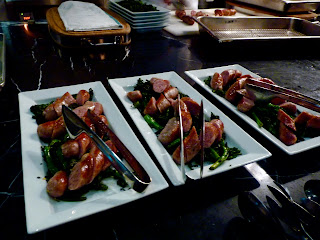
The second course was Salsiccia Fresca. The fresh sausage was served with grilled broccolini. Very smart to serve the plump, fatty sausages with the contrasting charred and slightly bitter broccolini. Not only did the broccolini provided a bit of relief, it knocked our socks off. Our entire end of the table was a-buzz about recreating it at home.


That is not to say that the sausages were anything but delicious. Their juiciness burst in your mouth, making you so sorry that you couldn't eat more.

The smart folks held back.

There were actually two sausages offered -- the regular and then my favorite -- the sausage with liver. One bite of the livery sausage sent me right back to my childhood. It must have been a memory of eating liverwurst. Fantastic!


Up next, something light -- Soffiata Di Parmigiano-Reggiano with Ragù di maiale.

Ahem, maybe not so much. That's Parmigiano-Reggiano soufflé with pork ragu, to you!


This course was sublime. Soft, warm, luscious. Everything you'd want to warm you on a chilly autumn evening, but yet absolutely desirable in the middle of summer.

It took an assembly line of men to plate this course. Slicing into these lofty soufflés required absolute focus. A light hand with the ladle was necessary for the saucing. And a quick flick of the wrist scattered the Parmigiano-Reggiano over all.


The course that followed was the epitome of how I like to eat. The Arrostito Spalla Di Maiale was an absurdly beautiful roast shoulder of pork served with a chicory salad. Rich roast meat with a bracing salad is the stuff of deep longing.


Oh, pork shoulder! I adore you!

The shoulder is a fatty cut of meat that yields the most succulent results. This was no exception -- salty, unctuous and divine.

Just look at that roast!

The bite of the emerald salsa verde was an exceptional counterpoint to the sweet pork. I liked that this particular salsa verde was very heavy on the parsley. The flavor provided a clean green lift to the swine.


Our final pork course was Costelleto Di Maiale with cippolini al forno. As you might expect, this was not your run of the mill pork chop with roasted onions. Not by a long shot.


Please notice the girth of these chops.

They sat perched upon their porcine post gloating at us throughout the meal, waiting for the finishing fire before joining the sticky sweet alliums on our plate -- the pig's final hurrah!


Chef Colby was kind enough to let us know that of the entire pig his favorite bit was the fat near the bone on these chops. That announcement sparked a spontaneous group gnaw on the bones-o.

A nibble then pass to the right!

No doubt about it. This is family dining!

The chops were liberally dusted with fennel pollen. I bought a tin of this powdered gold, when I first purchased Silverton's A Twist of the Wrist. The pollen has an earthy flavor that comes close to capturing the essence of wild fennel. Perfect with the moist meat.


Exhausted and full as never before, I didn't think I would have the stomach to try the Gelati E Sorbetti, let alone the coconut almond biscotti. But a funny thing happens when you've been gorging on such culinary mastery.

You can't help yourself.

You dive head first into the vat of plum, greek yogurt, and fruit of the woods gelato and sorbet. And the plum! Oh, my. It smacks you in the face with a plum flavor that is almost more pure than biting into the most luscious Santa Rosa.


I have no idea how they did that.

This epic experience costs $75 a person without wine. There are five wines to choose from running from $48 - $85. Or you may select one of three beers on the menu, all priced at $7.

You will likely have spent a fair amount of money once you're through at the Scuola, but in the end this feels like the best deal in town. And although it took us until Monday to fully recover, I cannot recommend Mangiare In Famiglia enough.

Mozza2Go/Scuola Di Pizza
6610 Melrose Avenue
Los Angeles, CA 90036

323-297-1133