Showing posts with label main. Show all posts

Wednesday, January 25, 2012

Sopa De Fubá - Collard Greens, Cornmeal and Sausage Soup


Today it's going to nudge 80 degrees. It's January for goodness sake! What is going on here? Last week it was cold and a touch rainy. Today doesn't necessarily feel like soup, but a couple of days ago it surely did.


Thanks to the outstanding Silver Lake Farms C.S.A. I belong to, I had a smallish bunch of young collard greens in the crisper and a tempting bunch of purple Russian Kale, and the desire for something warming in my toes. I had glanced up at the teetering stack of aging issues of Saveur magazine piled on top of my old wood filing cabinet, when I spied a spine that promised recipes for collard greens. Flipping through, I discovered a recipe from Brazilian food-blogger Neide Rigo unlike any I had tried before. Sopa de Fubá, a robust Brazilian soup of collard greens, cornmeal and kielbasa sausage, looked to be just what I craved.

I luckily found myself in the Fairfax district later that day so a visit to the seriously lovely ladies of the Lindy & Grundy butcher shop was in order. I picked up a few gorgeous plump kielbasa that turned a wonderful soup into a knock-out. Spicy!


Always the skeptic, I had doubts about the lack of garlic or onions, the absence of any spices or herbs, and the apparent watery quality of the soup during the early stages of cooking (it didn't look like the picture in the magazine!). The recipe is really quite simple. The main ingredients are cornmeal, kielbasa, chicken stock, collard greens, eggs, and a garnish of green onions. I was stumped as to how this was going to evolve into something marvelous.

The trick is toasting the cornmeal. This results in a richer flavor for the soup and perfumes the house with a toasty sweetness. The other thing to remember is the intense flavor of the kielbasa sausage. You don't need any spices competing with the boldness of kielbasa.


I've never made a soup with cornmeal. I expected the soup to thicken up markedly, but when you are using only half a cup of cornmeal to seven cups of chicken stock, this clearly isn't going to happen. It's actually the two lightly beaten eggs that provide most of the body to the Sopa de Fubá. And there's plenty of body at that. The soup is hearty and thick, laced with the green collards (I used half kale and half collards, contentedly), and peppered with spicy chunks of sausage. The flavor is powerfully delicious. Just be sure to taste before you salt!

A few notes. The cornmeal I used took only thirty minutes to become tender, so be sure to taste along the way. Also the greens took closer to ten minutes to wilt. This will depend on the size and age of your greens.


The recipe suggests that it will feed six. Perhaps. As a first course, you'd be fine serving six. I served this as an entrée with a salad and loaf of crusty bread to a hungry man and a very hungry pregnant woman (me!) with only enough left for one. I was wary of reheating the soup, but was pleasantly surprised by how good the soup tasted a few days later.

Sopa De Fubá - Collard Greens, Cornmeal, and Sausage Soup

1/2 cup yellow cornmeal
2 tablespoons canola oil
6 ounces kielbasa sausage, cut diagonally into 1/4-inch thick slices
7 cups chicken stock
4 ounces collard greens, stemmed and thinly sliced crosswise
2 eggs, lightly beaten
Kosher salt and freshly ground black pepper, to taste
2 scallions, thinly sliced

Heat the cornmeal in a 10" skillet over medium-high heat and cook, swirling pan constantly, until lightly toasted and fragrant, about 3-4 minutes. Transfer cornmeal to a bowl; set aside. Heat oil in skillet and add sausages; cook, turning occasionally, until browned and cooked through, about 10 minutes. Transfer to a plate and set aside.

Bring chicken stock to a boil in a 6-quart pot over high heat. Whisk in reserved cornmeal, reduce heat to medium-low, and cook, whisking often, until cornmeal is tender, about 40 minutes. Stir in reserved sausages and collards and cook, stirring occasionally, until collards wilt, 15 minutes. Place eggs in a medium bowl and add 1 cup cornmeal mixture; whisk until smooth. Return mixture to pot and stir until incorporated; cook for 1 minute more and season with salt and pepper. Ladle soup into serving bowls and garnish with scallions; serve hot.

Serves 6


Tuesday, April 12, 2011

Cioppino


Joseph had decided our next cooking collaboration should be Cioppino. Boy, was I game! I frequently dream of the blackened Le Creuset pots filled with the piping hot sea stew that they serve at the Sea Chest in Moonstone Beach, just a few hours up the coast from Los Angeles.

We needed a solid recipe that could compete with all the fabulous Cioppinos that Joseph has eaten by his father's side. If you look around, you'll notice there are tons of recipes for Cioppino. We were searching for something sparkly with a touch of wow-factor.

Strangely, right at the start of our quest, Jonathan Gold, Los Angeles' revered Pulitzer Prize winning food-writer, put out a call for questions from his fan-base on Facebook. He promised to try to respond regarding all manner of subjects from Los Angeles restaurants, to baking tips, to courtship advice, and even Rodarte's fall line.

Ambitious man!

Here was our ticket to the perfect Cioppino recipe. I immediately requested the best Gold had to offer. And guess what. He responded!


He recommended a Tadich Grill recipe that appeared in Saveur magazine a few years ago. Gold emphasized that this was in no way his Tuesday-night Cioppino, but a far more luxurious Saturday-night affair.

Cioppino is actually something of a poor man's fish stew originating out of fisherman culture in the late 1800s in San Francisco. Cioppino was originally made with the odd bits and leftovers from the day's catch. If you've made it yourself, you'll realize that it costs a fair bit more than a poor man's pay to actually make this dish.


In typical Joseph and Jacqueline fashion we went overboard. Big time. Jonathan Gold mentioned showcasing the beautiful Alaskan halibut that is just coming into season. I was with him completely. And it wasn't until we were paying that I realized that a pound and a half of that beautiful white flesh cost us fifty big ones.

Yikes!

I can't even tell you how much we spent on the crab legs. But it was a dazzling success of a dinner. A bubbling cauldron of red, overflowing with plump sea scallops, sweet shrimp, first of the season halibut(!), briny manila clams, lump crab meat and king crab legs, is a decadent stew well worth sharing.


Jonathan Gold conspiratorially advised against mentioning the two sticks of butter in this dish to anyone. And truth be told, we didn't whisper a peep about it to our guests. Of course, I have to be straight with you. Let's face it, that is no small serving of butter. There is no denying however, that it produces a stunning velvety effect.

The stewy broth takes a bit of work -- plenty of chopping and two hours of simmering -- but that kind of care develops a deeply flavorful base for this Cioppino. Dredging the seafood in flour and browning all of it is the kind of last minute, pain-in-the-assiness that I often steer clear of the night of a dinner party, but when you've got a three-man team working on the production, it's no big thing.


Our dear friends and family were delighted, and we were very pleased. I feel good about recommending this recipe to you, despite the fact that I have a couple of reservations.

In the end I am more of a soupy Cioppino girl. This recipe is best suited for those of you who enjoy a thicker, stewier Cioppino. Now, I may have allowed the sauce to reduce a little bit too much or perhaps we could have used a slightly lighter hand with our dredging. The butter likely contributed to this thicker, richer experience as well. I might tinker with the recipe a touch to arrive at a brothier outcome.


Those qualms could easily be due to user error. The only other issue I had was with the use of green bell pepper. And that is definitely just a personal preference issue. I'm not a big fan of green bell peppers any more. This recipe only calls for one, but the flavor is distinctly there in the forefront of every bite. It brought a definite cajun jambalaya/gumbo flavor to the Cioppino that I did not love or think really belonged. I might substitute a red pepper or omit the bell pepper all together in the future.

Just two other small notes. We added king crab legs, giving a half of one to each guest. For me this was a revelation. At thirty-eight years old, I'm not sure how I've missed these my whole life, but wow! The crab meat was incredibly sweet and tender and so easy to get at -- a really great addition to the dish.

And finally, back to the fifty-dollar halibut. I feel like a less fabulous fish, would do just as well in this Cioppino. The flesh falls apart too much to fully appreciate the halibut's wonderful texture and taste.


Other than those bits of nit-pickiness, I can whole-heartedly suggest you make this quite spectacular Cioppino for your next spendy dinner party. Your guests will be in for a real treat. Just don't forget to serve it with a crusty sourdough boule, and some Irish butter (conveniently available at Trader Joe's these days!).

Tadich Grill Cioppino

1 medium yellow onion, peeled and chopped
2 medium carrots, peeled, trimmed, and chopped
1 rib celery, chopped
1 green bell pepper, cored, seeded, and chopped
1 leek, white part only, trimmed, cleaned, and chopped
1/2 small fennel bulb, trimmed and chopped
2 28-ounce cans crushed Italian tomatoes
2 tablespoons tomato paste
4 bay leaves
1 teaspoon dried oregano
1 teaspoon dried thyme
1 teaspoon dried basil
2 pinches cayenne
Salt and freshly ground black pepper
2 cloves garlic, minced
1 1/2 pounds halibut filet, cut into large pieces
16 sea scallops
16 large shrimp, peeled and deveined
1/2 pound raw bay shrimp, if available, or smallest shrimp available, peeled
1-2 cups flour
12 ounces crabmeat, preferably dungeness, picked over
2 cups dry white wine
16 manila clams, scrubbed
1/2 bunch parsley, chopped

Warm 1/2 cup of the oil and 8 tablespoons of butter in a big pot over medium heat. Add the onions and cook for 2 minutes. Stirring frequently add the carrots, celery, peppers, leeks, and fennel, cooking for approximately 5 minutes. Add the tomatoes and tomato paste, 4 cups of water, the dried herbs and cayenne. Season with salt and pepper. Bring to a boil, and then lower the heat to low. Simmer for 2 hours stirring every so often.

Heat the remaining 1/2 cup oil, and 8 tablespoons butter in a large heavy pan over high heat. Add the garlic and cook until fragrant, approximately 1 minute. Dredge the halibut, scallops, and both sizes of shrimp, in the flour. Be sure to shake off any excess flour. In two batches, cook the seafood until golden, approximately 2 minutes. Transfer with a slotted spoon to the sauce pot and add the crabmeat. Cover the pot and simmer for 10 minutes.

Add the wine to the pan and heat over high heat. Scrape up any browned bits from the seafood. Add the clams and cover. Cook until all the clams have opened, approximately 5 minutes. Toss out any clams that do not open. Add the clams and the broth to the pot. Taste for seasoning and adjust accordingly. Serve in large bowls, garnished with the chopped parsley.

Serves 8


Friday, January 14, 2011

Sole Fillet Rolls Stuffed with Herbs


For quite a long time I had a very small-minded opinion of Greek cuisine, not having a clue about how much that region had to offer. Back in my early twenties, I thought Jeffrey Steingarten said it best when he quipped in The Man Who Ate Everything:

Typical of modern-day Greek cuisine are feta cheese and retsina wine. Any country that pickles its national cheese in brine and adulterates its national wine with pine pitch should order dinner at the local Chinese place and save its energies for other things.

Sheesh.

With great relief, I can say that my beliefs have evolved over the last fifteen or so years.

Phew.


Although it's probably a little early for me to have a definitive opinion on the 700-plus page Greek Joy of Cooking, Vefa's Kitchen, I think it's safe to say that it will dramatically help me continue to expand my knowledge and appreciation of Greek food.

Vefa's Kitchen has put something of a spell on me. Every time I open the book randomly, I find something new I want to whip up. It's as if I've been granted entry into a foreign land. The recipes are for dishes that I've never prepared before, that I haven't conceived of at all. And thankfully, so many of them seem completely realistic for my life at this time. The glossy pages feel good to my fingertips. The photographs are gorgeous and there are lots of them, which I really appreciate in a cookbook.


Fish was what I had in mind, and while I was tempted by many of the salt cod preparations, I didn't want to wait the extra day or two (required for soaking) for dinner. I selected a recipe, Sole Fillet Rolls Stuffed with Herbs, that was perfectly suited to satisfy two of my strong desires -- one for fish, the other for greens.


This sole recipe is an elegant preparation. Rolling up sole around a savory herb and onion mixture makes so much sense. I can't believe that I've never rolled sole before! It's so easy to manipulate before it is cooked. The contrast of colors between the white flesh, emerald green spinach (or sorrel) and brilliant red tomatoes is stunning.


Onion (try finely chopping, instead of grating), garlic and scallions are cooked until translucent in olive oil. The half cup of parsley and half cup of mint that are then added give the dish a remarkably fresh and healthy flavor. A good portion of this mix is used to stuff the sole. The rest is folded into the blanched spinach.


I opted for spinach because it was the easiest to come buy in great quantity, but the recipe first suggests sorrel. The sorrel would probably have lent the lemony note that I felt the dish was missing. If you use spinach, my recommendation would be to add lemon at some point, either during the cooking process or at least at the end, to finish the dish. You'll want a little brightness and acid.


I dig the hint of spice that comes from the nutmeg that is sprinkled on the fish. The recipe calls for ground, but I preferred grating my own.


Rolling up the fish is a cinch. The rolls are placed on the bed of greens and topped with a slice of tomato. Those red slices bathe each roll in sweet juices during the cooking -- another very good idea.

The remaining olive oil is then drizzled over the fish. Here, I might suggest one other small change. You're asked to pour a half cup, minus two tablespoons, over the dish. That seems excessive to me. I'd go just shy of a third of a cup or perhaps even a little less.


Psst. I also didn't brush my baking dish with oil. Depending on your ovenware, you probably can skip this step.


The sole cooks for approximately twenty minutes in a 400 degree oven. You could serve it alone, but I opted for a little mound of basmati rice to soak up the herbaceous juices. Delicious! I felt quite proud to be serving such a beautiful meal.


If you're not going to eat it all in one sitting, I'd recommend halving the recipe. The sole does not reheat well, which I knew would be the case and foolishly ignored. While I loved the meal the first night, I did not at all the second time around.

Sole Fillet Rolls Stuffed With Herbs

1/2 cup olive oil, plus extra for brushing
8 sole fillets, 3 1/4 lb total weight, skinned
Salt and pepper
1/2 teaspoon ground nutmeg
1 onion grated
2 garlic cloves, finely chopped
3 scallions, thinly sliced
1/2 cup finely chopped fresh mint
1/2 cup finely chopped fresh parsley
1 pound 2 ounces sorrel leaves or spinach, coarse stalks removed
2 small tomatoes, sliced

Preheat the oven to 400 degrees and brush an ovenproof dish with oil. Season the fish fillets with salt and pepper and sprinkle with the nutmeg. Heat 2 tablespoons of the oil in a pan. Add the onion, garlic, and scallions and cook over low heat, stirring occasionally, for 5 minutes, until softened. Stir in the mint and parsley, season with salt and pepper, and remove from the heat. Briefly blanch the sorrel or spinach in boiling water and drain. Spread 1-2 tablespoons of the onion and herb mixture over each fish fillet and roll it up. Mix the remaining onion and herb mixture with the sorrel and spread out over the base of the prepared dish. Put the sole rolls on top. Place a tomato slice on top of each roll. Season with a little salt and pepper and drizzle the remaining oil all over the fish. Bake for 20 minutes, or until the vegetables and fish are tender.

Serves 4


Tuesday, August 31, 2010

Swiss Chard Flan


My father said, "that does not sound good."

That was after I mentioned that I would be making Swiss Chard Flan for dinner. To him the idea of swiss chard and flan in the same meal was completely unappetizing.


Being the horribly indecisive person that I can be, his comments through me for a loop. My whole plan for dinner was flying out the window.

Should I switch to couscous? Not pasta again. It's Meatfree Monday! What do I cook?

After a few hours of that nonsense, I came back to my original plan -- Swiss Chard Flan from Canal House Cooking Volume 1. I promise I am going to stop with all of this Canal House Cooking Volume 1 business.


Easy for me to say, because I just purchased the next three volumes! I am a very proud owner. Please go to the Canal House website, buy their books, and become a subscriber. As I've mentioned before, Christopher Hirsheimer and Melissa Hamilton are capturing the spirit of food, good cooking, and swell living in exactly the manner that I would like to. Their style is simple and seasonal. Their photography is gorgeous.

Go see!

The Canal House women are using the term flan loosely. My efforts did not produce a creamy custard. This particular flan is more closely related to a frittata. Certainly, there are fewer eggs and more cream here, but in no way are you getting a crème caramel with greens in it.


The shopping list is short -- olive oil, onions, garlic, swiss chard, half-and-half, heavy cream, eggs, and parmigiano-reggiano. You probably have most of that in your kitchen already. The preparation is quick. The cooking time is about an hour.

Just start early, because the idea is to eat the flan at room temperature. Needless to stay, starting to prepare this dish at 8:15 at night will likely mean you are eating your flan, hot. This is not necessarily the end of the world. It was quite tasty hot, but eating it at room temperature for lunch today was better.


You chop. You sauté. You wait.

The recipe suggests you use two bunches of chard. Oh, how I hate that kind of instruction. The size of a bunch of chard is so variable. I used one and a half bunches. It was about six cups of chopped leaves. This seemed like plenty of chard. Perhaps the dish would have been more custardy with less. I was satisfied with the egg to vegetable ratio.

One other note on the chard. Give it a spin after washing it. Just as with the Spinach Cake, you do not want a watery final product. Without spinning the greens, you will likely have a flan that is leaking puddles of liquid.


After all the sautéing, you pour the egg and cream mixture over the vegetables. The recipe gives you the option to cook the dish entirely in the oven or on the stove for twenty minutes with a quick finish under the broiler. I opted for the latter.


The parmigiano-reggiano sprinkled over the flan will turn a deeper golden brown under the broiler. I used a modest amount of the cheese -- just enough to lightly finish the dish. You don't need much. There is already a cup of half-and-half and a half cup of heavy cream here.

No need to further overdo it.


That being said, this dish does not seem at all heavy. It has quite a lot of chard in it. So while you may feel a little guilty about the cream, you do feel quite virtuous about all the greens you are eating. The chard has a wonderful sweet flavor that is nicely complemented by the salty cheese.

We ate the swiss chard flan with a bit of warm bread and a crisp green salad, dressed with olive oil, lemon, garlic and anchovy. Not bad for a Monday. Also most appreciated by myself and Fe, this Tuesday.


Swiss Chard Flan

3 tablespoons extra-virgin olive oil
1 large yellow onion, chopped
1 clove garlic, minced
2 bunches young chard, stems and leaves chopped separately
3 eggs
1 cup half-and-half
1/2 cup heavy cream
Salt and pepper
Grated parmigiano-reggiano

Heat the olive oil in a large non-stick heavy skillet over medium heat. Add the onions and garlic and cook for about five minutes, until tender. Add the chard stems and cook covered for 10 minutes. Add the leaves and cook covered until wilted, about 10 minutes

Beat the eggs, half-and-half, and cream in a bowl. When the chard has wilted, season it with salt and pepper. Pour the egg mixture over the chard. Reduce the heat to low, cover and cook until the custard has just set, approximately 20 minutes. It may still be a bit jiggly in the center.

Preheat the broiler. Sprinkle the cheese over the top, and brown the flan under the broiler. If the handle of your skillet is not ovenproof, leave the door ajar. Serve the flan from the pan or from a platter. Serve at room temperature.

Or cook the flan in a pre-heated 375 degree oven the whole time. It will take about 45 minutes.

Serves 4-6


Saturday, August 21, 2010

Steamed Mussels


Like many folks, I spent my junior year in college abroad. The obvious choice for me was France, considering my French Canadian background and the fact that I'd been studying French since seventh grade.

I arrived in Bordeaux without a clue about living on my own, cooking for myself, or what it would be like to be so far from my family.

They were back home in Los Angeles. And although I had spent my first two years in college in Santa Cruz, three-hundred and fifty miles is nothing compared to the vast stretch of the United States and the Atlantic Ocean that now separated us.

It was heartbreakingly hard.

My homesickness was overwhelming throughout the fall. Christmas was the turning point for me, and it had everything to do with food.

My utterly crazy boyfriend from Santa Cruz was visiting. It was my first Christmas away from my family. The way I coped with the separation was to cook up a Christmas like I would have at home for the two of us -- luscious rare beef and ultra-rich Yorkshire pudding.

I'll share those recipes when it is seasonally more appropriate!

This is all to say that cooking is what turned my whole year around. It opened up everything. I had cooked side by side with my mother, but having lived in the dormatories the first two years away from home, I had very little experience cooking for myself.

I ventured into my new cooking life with only a paperback edition of the Joy of Cooking and a lot of enthusiasm.

I remember attempting soup for the first time and ending up with a flavorless puddle after three hours. I had so much to learn.

I was adventurous. Chicken Kiev, anyone? It's warm! Let's have gazpacho!

Eating in Bordeaux was wonderous. Walking to the corner boulangerie for a buttery pain au chocolat that would leave tiny flakes on your lips was the stuff of great romance.

Riding on the back of the baker's motorcycle out to the coast for oysters and wine made from grapes grown just around the bend was rather romantic too.

One of my housemates in Bordeaux was a Frenchman named Patrick. He introduced me to rillettes from his home-town, LeMans. The only place to get proper rillettes! Or so says Patrick. My love for the fatty, earthy pork is as strong today as it was after my first dip into the little crock that he had brought home for us.

He also taught me how to make mussels. Steamed mussels as good as at any French bistro in this country or his. The simplicity of it is impressive -- a little garlic and some shallots, white wine, parsely and mussels. And ten minutes. Just ten.


What puzzles me is why it has taken me until just a couple weeks ago to recreate these mussels in this country. I'd see the shiny black mollusks at the fish market and feel, get this -- intimidated!

Absurd!

I'd absolutely forgotten the ease of their preparation. I can't let any more time pass without sharing this recipe with you, in case you, dear readers, have been suffering from the same sort of mental confusion.

I eat moules frîtes in restaurants frequently, and those preparations have nothing on these. My sister ordered the very dish at Bouchon just a few weeks ago and these were on par with those without a doubt.

I don't make frîtes at home, and if I am going to be honest right now I am a little bit sick of them. My preference is to serve them with a crusty, chewy loaf of bread, a green salad and an exceedingly dry Riesling.


The evening I made these steamed mussels, I was feeling particularly extravagant and actually served them with chanterelle toasts -- decadent and sublime.


I was so tickled by the success of the mussels that I gave them another go a couple of nights ago. To keep my parents and sister happy, I substituted clams for half of the mussels. The preparation is exactly the same and the results just as pleasing.

In Los Angeles, you can pick up mussels at most markets, but I found the mussels from the Hollywood Farmer's Market to be especially nice, as were those at McCall's in Los Feliz.

The mussels will need cleaning. Be sure to give them a good scrub and to de-beard them. De-bearding just means to yank the fibrous strands out of the mussels -- very easy, I swear.

You may be surprised by how much garlicky sea broth you get using only half a cup of white wine. The mussels release a lot of liquid, which you will be very happy about -- the more briny liquor the better! That's what the bread is for!

I've also been know to slurp it right out of the bowl.


Steamed Mussels with Garlic and Shallots

5 pounds black mussels (figure about a pound per person)
4 tablespoons butter
2 shallots, minced
5 cloves garlic, minced
1/2 cup dry white wine
A handful or two of chopped parsley

Clean the mussels.

Melt the butter in a good sized heavy pot. Sauté the shallots and garlic over medium high heat until soft, about five minutes. Add the mussels and white wine. Turn heat up to high and cover. Cook for ten minutes, shaking the pot every few minutes. Check the mussels. They should be open. If not, give them a couple more minutes. At this point they really should all be open. Discard the few that may not be. Scatter parsley all over and serve in deep soup plates with plenty of broth.

Serves 4 to 5

Friday, July 30, 2010

Tuna Steaks Braised with Radicchio, Chickpeas & Rosemary


I thought I'd continue my attempt to seduce you with recipes from the extraordinary All About Braising by Molly Stevens. So, I prepared her Tuna Steaks Braised with Radicchio, Chickpeas and Rosemary for dinner last week.


I tend to braise beef, pork, and vegetables the most. When it comes to fish, I usually fall back on roasting and sautéing, although I have been known to fry up some pretty good catfish.

Braised fish just isn't a big part of my repertoire.

As I mentioned previously, it is important to mix things up. Writing a blog is very helpful in identifying the
rut that you may be stuck in at any particular moment.

I mean, just how many times can I mention roasting salmon, before I bore you to tears?!

And enough is enough with the pork already!


I am very tired of seared tuna.

Braising tuna is a pleasant change. Marrying the braised tuna with braised radicchio and chickpeas that have first been sautéed with rosemary and garlic infused olive oil produces an unusual yet elegant dinner.


The herbaceous oil and the radicchio and chickpeas are so well suited to each other that I would very happily make only this part of the dish and serve it alone for lunch or as a side to other proteins like grilled rib-eye or roasted chicken.

I think braised chicories are divine, whether it be radicchio, endive, or escarole. Their pleasing bitterness turns slightly sweet and luscious.

We should all be eating more of them!


I used Albacore tuna, but I'm curious if using Ahi tuna would have made an appreciable difference. I may try that the next time I'm feeling a bit more flush.


Braised in this fashion, the tuna is meaty and substantial. While this dish is certainly light enough to be enjoyed as summer-fare, it would be equally appropriate in the winter thanks to its warming soupiness, soft legumes and the use of piney rosemary.


This dish is delicious right off of the stove, but it also tastes terrific the next day served at room temperature. Don't try to reheat it, because it will become a dried out mess!

Tuna Steaks Braised with Radicchio, Chickpeas & Rosemary

1/3 cup extra-virgin olive oil, plus more for drizzling
4 garlic cloves, cut into slivers
2 teaspoons coarsely chopped fresh rosemary
1/4 teaspoon crushed red pepper flakes
1 medium head radicchio (about 6 ounces)
1 cup chicken stock
1 tablespoon freshly squeezed lemon juice, plus more to taste
One 15 1/2-ounce can chickpeas, drained and rinsed (1 1/2 cups)
Kosher salt
1 3/4 pounds tuna steaks (usually 2 good-sized steaks), about 1 1/4 inches thick
Freshly ground black pepper
2 tablespoons coarsely chopped flat-leaf parsley
Fleur de sel or coarse sea salt (
I used Maldon)

Combine the oil, garlic, rosemary, and pepper flakes in a medium high-sided skillet (10- or 12-inches). Heat over low heat, covered, until the garlic is fragrant, soft, and lightly golden, 4 to 5 minutes. Lift the lid frequently to check that the garlic isn't frying or browning. Set aside.

Cut the radicchio in half from core to top. Carve out the small core. Place the halves cut side down on a cutting board and slice into 1/2-inch-wide shreds. Add these to the infused olive oil Return the skillet to medium heat and sauté, stirring occasionally, until the radicchio is wilted, about 5 minutes.

Add the stock, lemon juice, chickpeas, and a pinch of salt to the pan. Bring to a simmer, cover, and simmer gently for 8 to 10 minutes.

Season the tuna steaks on both sides with salt and pepper. Set them on top of the chickpeas and radicchio, and reduce the heat to low. Cover and braise gently, lifting the lid once or twice to check that the liquid is simmering quietly, not violently. If necessary, lower the heat, or set a heat diffuser beneath the pan. After 8 to 10 minutes, the tuna steaks should be cooked halfway through. Carefully turn the steaks. Cover them with some chickpeas and radicchio. Replace the cover and braise gently until the steaks are just cooked through, another 6 to 8 minutes. Prod the center of a steak with a paring knife and peek to see that it's cooked to your liking.
Transfer the tuna steaks to a cutting board and divide into serving pieces. Set the tuna in warm shallow pasta bowls. Stir the parsley into the pan, taste for salt and pepper, and spoon the chickpea-radicchio garnish, along with plenty of liquid over the tuna. Finish each serving with a squeeze of lemon juice, a thread of good olive oil, and a pinch of fleur de sel or coarse sea salt.

Serves 4

Tuesday, July 27, 2010

Nigel Slater's Pork & Lemon Polpettine


I can't tell if I have built up enough cred with you folks to just tell you to try something. My gut tells me to go for it.

Trust me! These gorgeous little meatballs won't disappoint!

In the end, it isn't such a big leap of faith. I'm really asking you to believe in Nigel Slater. That's not so hard to do! He's a good egg, a passionate food-lover, highly regarded author and columnist, and celebrated home chef.

Trust him!

He calls these, "delectably moreish little balls." I find his writing and these scrumptious pork and lemon polpettine equally addictive.


You'll need ground pork, lemon zest and juice, fresh bread crumbs, grated parmesan, thyme, anchovies (I can't get enough of these little suckers, lately!), and parsley. The scent of a sour, salty sea breeze wafts up towards you when you mix these ingredients together.


And that's nothing compared to the aroma of these polpettine when they are cooking.


These little balls become delightfully sticky and crispy, so be sure to use a non-stick pan. After browning them, you let them simmer away in stock for a bit. The result -- a savory pan sauce that is perfect spooned over the polpettine and perhaps some slippery noodles as well.

I served them over a tiny grain-like pasta, but that seemed superfluous. I think the lemon polpettine with their juices drizzled over and perhaps a few slices of tomato and some garlicky greens are really all you need to be quite happy, indeed.


Nigel Slater's Pork and Lemon Polpettine


1 1/4 cups fresh white breadcrumbs
1 pound ground pork
1 lemon, zested and juiced
1 large handful of parsley, chopped
6 large sprigs thyme, leaves stripped from stems
2 heaped tablespoons grated Parmesan
10 anchovy fillets, chopped
Flour, for coating
2 tablespoons olive oil
3 tablespoons butter
3/4 cup chicken stock

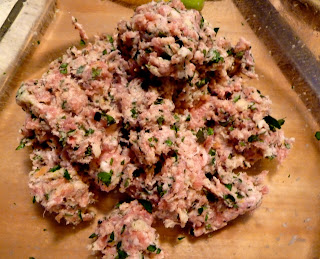
Combine the breadcrumbs, pork, lemon zest, lemon juice, parsley, thyme, Parmesan, anchovy in a large bowl. Season with salt and more generously with pepper. Mix thoroughly.

Make eighteen or so small balls of the mixture, using a heaped tablespoon of pork for each. Flattening each ball makes them a bit easier to cook. Roll the balls lightly in the flour.

Heat the olive oil and butter in a heavy non-stick pan. Fry the polpettine in batches -- perhaps eight to ten per. Cook for four or five minutes, until they are crisply golden on each side. Once you have done this with all them, put them all back in the pan and leave to cook through to the middle -- a matter or six to eight minutes more. Don't over-do it with the turning, so they are able to develop a nice crust and don't fall apart.

Pour out most of the fat and add the chicken stock. Leave to bubble for a good two or three minutes, scraping up any crusty bits. Let the stock reduce a bit and then serve the polpettine with the juices spooned over.

Serves 4

Tuesday, July 13, 2010

Dinner Diary: 7/09/10 -- Seared & Simmered Kurobuta Pork Chops


  • Sautéed Bordeaux Spinach with Garlic
  • Roasted Asparagus
  • Baked Sweet Potato
  • Seared & Simmered Bone-In Kurobuta Pork Chops


So far this Dinner Diary exercise has been good for me. It's reminding me that I need to strive for variety and the new.

It's easy to cook pork chops for dinner, but how can I make them a little bit different, a little more exciting -- besides adding a cup of cream?

I'll get you that recipe some time in the fall.

I like to flip through Mark Bittman's How to Cook Everything for new ideas. He does suggest that you will find out how to cook everything in his massive tome. I feel like every time I open it, I am challenging him.

It's fun!

A good pan sauce or frankly any kind of sauce can help jazz things up. And sauces are what have been on my mind of late.

I don't typically simmer pork chops, but this recipe produced very moist and juicy results, and leaves you with a rather nice pan sauce to dribble over.

This is what Bittman suggests (along with eight other ideas), and what I served last Friday night. Really simple, straightforward and satisfying. The super-high-quality Kurobuta pork chops from McCall's in Los Feliz guaranteed a fabulous dish.

Seared & Simmered Pork Chops

4 pork chops, about 1 inch thick
Salt and freshly ground pepper
2 tablespoons extra virgin olive oil
1/2 cup dry white wine
1 teaspoon minced garlic or 2 tablespoons minced shallot, onion, or scallion (I used garlic)
1/2 cup chicken, beef, or vegetable stock or water
1 tablespoon butter or more olive oil (I used butter)
1 tablespoon freshly squeezed lemon juice or vinegar (I used lemon juice)
Chopped parsley for garnish

Sprinkle the chops with salt and pepper. Put a large skillet over medium-high heat for 2 or 3 minutes. Add the olive oil; as soon as the first wisps of smoke rise from the oil, add the chops and turn the heat to high. Brown the chops on both sides, approximately 4 minutes total.

Reduce the heat to medium. Add the wine and garlic and cook, turning the chops once or twice, until the wine is all but evaporated, about 3 minutes. Add the stock, turn the heat down to low, cover, and cook for 10 to 15 minutes, turning the chops once or twice, until they are tender but not dry. When done, they will be firm to the touch, their juices will run just slightly pink, and when you cut into them, the color will be rosy at first glance but quickly turn pale.

Transfer the chops to a platter. If the pan juices are very thin, cook, stirring and scraping the bottom of the pan, until the liquid is reduced slightly. If they are scarce (unlikely), add another 1/2 cup of stock or water; cook, stirring and scraping the bottom of the pan, until the liquid is reduced slightly. Then stir in the butter or a few drops of oil over medium heat; add the lemon juice, pour over the chops, garnish with parsley, and serve.