Showing posts with label French. Show all posts

Thursday, January 19, 2012

Sautéed Shrimp in Pastis with Lemon & Cherry Tomatoes


I'm not sure if I've mentioned my fitful relationship with shrimp of late. In my heart, I love the curly shellfish. In practice this is less and less the case. The shrimp I've found in local markets and the frozen muck they sell at Trader Joe's has left me wondering what I ever saw in the pink crustaceans. In Puerto Vallarta last September, we were popping shrimp like no tomorrow. They were all scrumptious, succulent morsels. At home, not so much.


I realize that purchasing your shrimp at highly reputable vendors is the key to enjoyment. I'm currently stuck on McCall's Meat & Fish in Los Feliz. They're pricey as hell, but the quality is so high that you start to feel weird about shopping at lesser institutions like Gelsons (especially because their fish is expensive, yet lacking a healthy sheen and really tastes mediocre at best) or Whole Foods (because they are so expensive and their beef is lacking in tenderness and flavor). With McCall's, I've never been disappointed. I just can't afford to shop there exclusively.


Of course an outstanding preparation will certainly increase your odds of success. When I was preparing mussels with sherry and chorizo the other night, I started to remember a shrimp dish that I'd eaten back in Santa Cruz; something with cherry tomatoes and lots of butter. A quick phone call to my old pal, Eric, had me on the right track. He reminded me that it was a Gerald Hirigoyen (great Basque chef based in San Francisco) recipe that I was after.


Thank goodness for Google. I found the recipe I was looking for within seconds, and with a short trip down the hill to Cookbook for herbs, I was all set.

The recipe that I speak of is Hirigoyen's Sautéed Shrimp in Pastis with Lemon and Cherry Tomatoes. The preparation is ultra-simple. Making this on a weeknight is a breeze. I think your only complaint might be the liberal use of butter. The recipe is supposed to serve four. I used a pound of shrimp instead of a pound and a quarter and it served two with one serving left for little Fe. the next day (hurrah, he's finally allowed to eat shellfish!). That being said, a stick of butter may seem like an awful lot for a dinner for two and a shorty.

But what the hell?! You've got to let yourself go every so often and this dish is a perfect reason to do just that. Plus it's exciting! Pyrotechnics! You light the pastis (I used Ricard.) on fire!!


Flambé all the way!

I had trouble wrapping my head around the fact that the recipe does not call for garlic or shallots. It felt positively unnatural to make a sautéed shrimp dish without one or both. I'll tell you confidently that it actually does not need it. I couldn't help myself so I sautéed a crushed clove of garlic in the olive oil for a minute or two (then tossed it) before adding the shrimp. Truth be told, I could barely taste it and not for even one second did I miss the alliums.

You sauté the shrimp in the hot olive oil, add the halved cherry tomatoes, add the pastis, and then flambé until the flame dies out. You add lemon juice, herbs, butter and salt and pepper and simply swish the pan around until the butter is completely incorporated. Presto, your dinner is ready. Serve it with a small heap of fragrant rice for ultimate satisfaction or perhaps a nest of slippery noodles.


The recipe calls for basil, but I opted for tarragon since it pairs so well with pastis. The butter is cut into smallish cubes to ease the melting and emulsifying. You want to be sure not to boil the sauce or the lovely emulsion that results from your gentle pan swishing will break and the beurre-blanc like sauce will be shot. Careful!


This is a buttery, herbaceous dish full of basil (or tarragon), parsley and chives that packs a nice citrus hit from the ample use of lemon juice. The flambéed pastis adds a warm anise flavor that ties the entire dish together. It's quick work, but it would easily impress your Saturday night dinner guests.

Gerald Hirigoyen's Sautéed Prawns in Pastis with Lemon and Cherry Tomatoes

2 tablespoons olive oil
1 1/4 pounds shrimp (approximately 30) (I used fewer larger shrimp), shelled and de-veined
10 ounces cherry tomatoes, cut in half
3 tablespoons Pastis, such as Ricard or Pernod
3 tablespoons freshly squeezed lemon juice
8 tablespoons (1 stick) unsalted butter, cut into small pieces
2 tablespoons julienned fresh basil
1 tablespoon freshly chopped parsley
1 tablespoon snipped fresh chives
Kosher salt and freshly ground pepper to taste

Warm the olive oil in a large sauté pan over high heat. Add the shrimp and sauté for about 2 minutes stirring frequently. Add the tomatoes and the Pastis, and flambé until the flame dies out. Add the lemon juice, butter, basil, parsley, and chives and season with salt and pepper to taste. Swirl the pan over the heat just until the butter is completely melted into the sauce. Take care not to boil, or the sauce may separate.

Serves 4

Monday, March 28, 2011

Roast Pork with Mustard, Herbes de Provence & Thyme


I had to double check the index of recipes on this blog to believe that I had not yet written about one of the best recipes in my bag of tricks. Shockingly, it was nowhere in sight.

How could I do this to you, dear reader?

On Chowhound when you fill out your profile, they ask what your "go-to dinner party dish" is. I only put down two things, a sublime tomato soup and roast pork with mustard, herbes de Provence and thyme.

This pork has saved me countless times with guests and family, but for me the clincher is that it is one of my personal favorites. Every time I take my first bite I am astonished by how extraordinary this dish is. This isn't fancy cooking, rather it is rustic French farm fare. For me that is some of the best the culinary world has to offer.

I found this recipe for Roti de Porc au Thym (Roast Pork with Thyme) in the September/October 2001 issue of Saveur magazine. That particular magazine is covered in grease because I have put it to such good use. Inside you'll also find a terrific French lentil salad and my favorite recipe for Arroz con Pollo.

This is a recipe for those of you who don't have a lot of time for chopping and mixing and measuring, but are still foodies at heart and want the end result to be divine. If you can handle browning the roast, the rest of the process is a breeze.


The recipe calls for a boned pork rib roast, but allows for substituting the loin end, shoulder, or blade end. What I typically purchase at the market is the large pork loin roast (not the tenderloin!), because that is what I routinely find. Shoulder would be great too, if a little fattier. However the loin works well, and because of its even shape you don't need to tie it up.

The marriage of pork drippings, mustard, thyme and herbes de Provence leaves no room for wanting garlic or onions. The flavor is just right. I don't really use herbes de Provence for anything else, though I'd be willing. The hint of lavender seems exotic, as if you're walking through fields of purple flowers in France.

Ironically, according to Wikipedia, lavender is only added to the American blends of herbes de Provence. Is this true? The typical mix includes savory, fennel, basil and thyme. The mix I've used lately from Penzeys includes rosemary, fennel, thyme, savory, basil, tarragon, dill weed, oregano, lavender, chervil and marjoram. This might be overkill (although it's quite good), but I certainly wouldn't want to give up the lavender, no matter how much it screams American.


After browning the meat on all sides, dijon mustard is slathered over the top of the roast. The herbes de Provence are scattered over and thyme branches are placed on top. One cup of water is poured into the bottom of the pot. The pork in a heavy bottomed pot -- preferably of the Le Creuset ilk -- is covered and nudged into a 425 degree oven, where it cooks for just 45 minutes. Basting every 15 minutes is essential.


Your pork needs just a wee rest on the counter, maybe fifteen minutes, and then it is ready to carve. Right? It doesn't get much easier than that!


The pork is remarkably succulent. Carving the meat always produces a puddle of precious juices that must be guided with care back into the pot with the rest of the pan drippings. The resulting sauce is superb.


The perfect accompaniment that properly showcases the sauce is a tiny pasta. Orzo is my preference because I like how slippery it is and how that feels in my mouth, but fregola sarda or any of the other little babies will work well too.

I don't want to oversell this recipe, because I wouldn't want to disappoint you, but I'm using words like superb and divine with complete sincerity. I really think you'll love this dish.

Roast Pork with Mustard, Herbes de Provence & Thyme
Adapted from Saveur Sept./Oct. 2001 Roti de Porc au Thym

1 4 lb. pork rib roast, boned
Salt and freshly ground black pepper
1 tablespoon butter
1 tablespoon peanut or other neutral vegetable oil
1/2 cup dijon mustard
1 tablespoon herbes de Provence
6 branches fresh thyme

Preheat oven to 425 degrees. Place rack in the middle of the oven.

Generously salt and pepper the pork all over. Melt the butter and oil in a large Dutch oven with a lid that fits snugly. Brown meat thoroughly on all sides, about 5 minutes or so per side.

Turn the pork fatty side up, and spread with the mustard, evenly over the top. Crush the herbes de Provence with your fingers and scatter them over the meat. Rest the thyme branches on top of the pork. Add 1 cup water to the bottom of the pot and cover.

Put the pot in the oven and roast the pork, basting every 15 minutes, until the temperature reaches 135 degrees. This should take about 45 minutes. Remove the pot from the oven and set the lid ajar. Let the meat rest for 15-20 minutes. Discard the thyme branches, and place the meat on a carving board. Thinly slice the meat and serve with the pan juices spooned over.

Serves 6-8


Monday, March 21, 2011

Potato and Leek Soup


When it comes to potato leek soup, I am a purist. Fewer is better, as far the ingredients go. And the less fuss the better. Who needs to muss up the blender or food processor, when a piping hot bowl full of hearty hunks of potatoes and leeks is so satisfyingly rustic?

Of course, that doesn't mean that's your preference for soupe aux poireaux. And that is indeed the beauty of this potato and leek soup recipe. It is exceptionally customizable. Feel free to purée, and why not throw caution to the wind and serve this puréed and chilled.

Mmm, Vichyssoise.


I've come to think of this recipe as a family heirloom, but that isn't exactly correct. We've eaten many pots of this soup in my family. So it seems like my mom's recipe, but it comes -- along with many other family classics -- from the New York Times International Cook Book.


I took this recipe in a notebook of other photocopied hits with me to college. This potato and leek soup along with a terrific tomato soup from the same book were two of the first dishes in my measly 18-year-old repertoire. I made it again last night for the whole family, Fe. included, and it is still something of a show-stopper.

I highly recommend a double recipe.


This simple yet decadent soup cannot be part of our regular rotation, because it is full of cream and butter. Full. But on a cold and stormy first day of spring, it was really quite perfect.


I'm not kidding about the simplicity. Anyone can make this potato and leek soup. Chop the leeks and onions. Sauté in butter. Toss in the potatoes and chicken stock. Simmer. Add a generous quantity of cream. Salt and pepper. Garnish with chives. Slurp embarrassingly.


See. You can do it in your sleep!

Potato and Leek Soup

2 large leeks
1 medium onion, chopped
3 tablespoons butter
2 medium potatoes, peeled and cut into 1/2-inch cubes
3 cups chicken stock
1 cup heavy cream
Salt and freshly ground black pepper
Chopped chives (optional)

Trim the root end of the leeks, then cut off and discard approximately half of the green stems. Slit the leeks several times lengthwise from the stem and rinse well under cold water. Leeks can be very dirty! Chop the leeks and cook them with the onion in the butter. Cook for three minutes, stirring.

Add the potaoes and stock and bring to a boil. Simmer about fifteen minutes, or until the potatoes are tender. Add the cream and bring just to a boil. Season with salt and pepper to taste and serve hot with chopped chives.

Serves 4


Saturday, November 27, 2010

Happy Thanksgiving Cheese Puffs


A belated Happy Thanksgiving to you all!


I meant to shoot up a storm and take pictures of every aspect of our Thanksgiving dinner, but things never go the way you plan when you're cooking like a mad woman and entertaining. Even though the truth of the matter is that my mom did most of the heavy lifting.

Shh.


That woman is a rock star when it comes to the barbecue and when it comes to turkey. A gorgeous, crispy-brown, barbecued turkey was the centerpiece of our Thanksgiving meal. I'm not going to tell you how to do it, but I have to recommend preparing your bird this way at least once. It tastes smoky and fantastic.


We supped on carrot and cilantro soup, stuffing with dried apricots, giblet gravy, candied sweet potatoes with raisins, sautéed spinach with pine nuts, garlic and currants (one of my contributions) and cranberry sauce.

Of course we had sliced canned cranberry jelly on the table as well, because there are always at least two people in every family who do not want to give it up for anything.

Pumpkin pie -- yes sir! With whipped cream or crème fraîche.

But what I really want to tell you how to make is cheese puffs.


I was the most proud of the ultra-cinchy to make French Cheese Puffs from Canal House Cooking Volume 2. This is one of those recipes that makes you look like a sophisticated pro in the kitchen.


The puffs themselves are the height of sophistication -- airy and light, yet rich and buttery. These cheesy beauties are an elegant start to a fête -- definitely spectacular with a bottle of something bubbly. I see these as a natural for an intimate New Year's Eve dinner party with a bottle of Veuve Cliquot.


I used the exceptional Irish Kerrygold butter and a cave-aged raw milk gruyère. Delicious ingredients always help. You'll need to do a little heating, a fair amount of stirring -- at times vigorously -- and some spooning. Twenty minutes in the oven and that is all.

I actually completely forgot about the penultimate step in this recipe -- brush the dough with milk. I suppose my cheese puffs would have been shinier, but you couldn't tell that anything was missing at all.


Be sure to time things right, so that you are serving these warm, just moments out of the oven. These were a big hit with everyone from my husband and mother-in-law to nearly two-year old Fe.


If for some strange reason you have leftovers, store them in the fridge and heat them up for breakfast the next day. They won't be as amazing, but the warm cheesiness will start your day just right.


Canal House Cooking French Cheese Puffs

8 tablespoons butter
1 1/4 cups milk
2 pinches salt
Pepper
1 cup flour
4 large eggs
1 cup grated Comté or Gruyère cheese

Preheat the oven to 400 degrees.

Heat the butter and 1 cup of the milk over medium heat in a heavy saucepan until the milk is hot and the butter melted. Add the salt and a couple of grindings of pepper.

Lower the heat to low, and dump in all the flour at once. Stir vigorously, until a dough forms a thick mass and begins to pull away from the sides of the pan.

Remove the pan from the heat and beat in the eggs one at a time, until each egg is completely incorporated into the dough before adding the next. The dough will be smooth and shiny. Stir in the cheese.

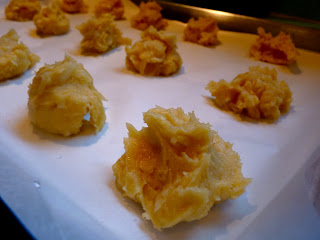
Spoon walnut-size spoonfuls of dough onto parchment-lined sheet pans. They should be about an inch apart. Brush the tops of the puffs with the remaining milk to make them nice and shiny.
Bake until puffed up and golden, about 20 minutes. Serve warm.

Makes about 3 dozen.